
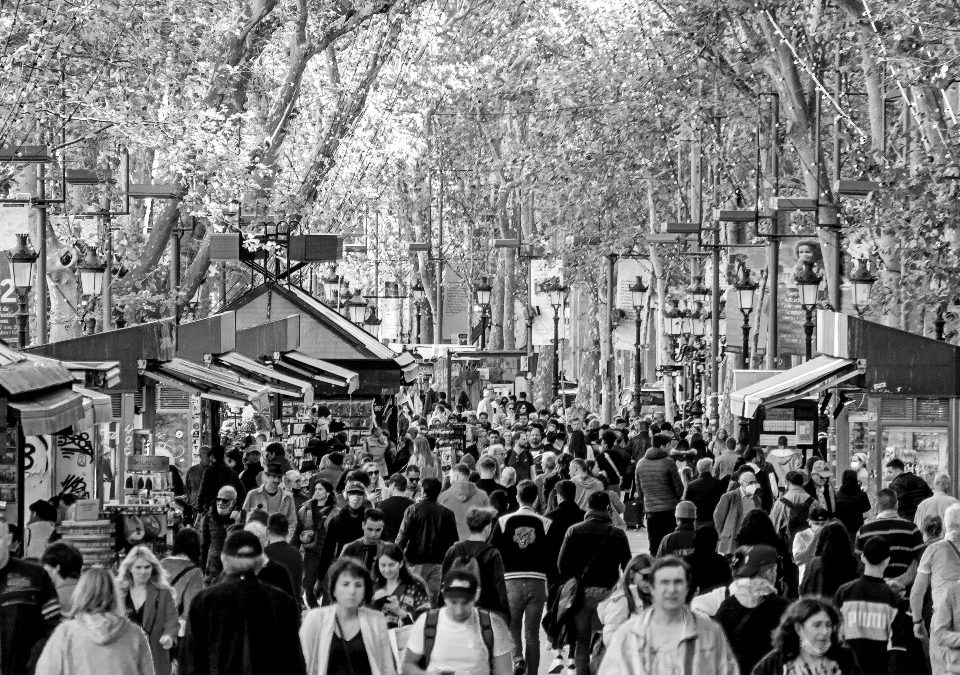
After the hard shock of the pandemic, tourism is back to track. In the current ‘recovery phase’, we are witnessing a rebound of an unprecedented rapidity: three years ago, we were locked in our homes and the industry came to a virtual halt. Three years later, the situation seems best defined by the expression “business as usual”. Has the industry learnt something in the interim?
Tourism has become in recent years quite a divisive matter: everyone wants its benefits, but few seem ready to put up with the burdens which come along with the development of tourism. On the one hand, it creates jobs. On the other hand, these are mostly temporarily and low-paid. On the one hand, it provides a substantial revenue to bars and restaurants. On the other hand, it brings noise and nuisance to residents – especially when activities or flows of people go through residential areas. It makes us proud that visitors come to see our monuments, but we dislike seeing the masses on the streets. Barcelona -and the most important urban destinations in Europa -can attest to these issues. With the recovery of business this year (in the recent Easter holiday, Barcelona has had a staggering 87% in hotel occupancy) the much-debated question about tourism’s benefits versus burdens comes back into focus.
At Ciutat Nova, we are all passionate about means and tools that help people meet, share and exchange about their life or cultures, contributing to an understanding among different groups. Tourism is -potentially- a wonderful tool in this respect as it brings people together and may help in overcoming prejudices and creating long-lasting relationships among individuals and, at a larger scale, among nations. This has been for years the discourse of the World Tourism Organization (UNWTO), an agency which is part of the United Nations, and many other public officers. However, on-the-ground experiences and academic research suggest that this is not an automatic process: this “contact hypothesis”, i.e., the idea that just by traveling somewhere one may lay aside prejudices, is not a straightforward matter. For one thing: how many of the visitors coming to Barcelona (and Paris, Rome, Amsterdam or Munich) engage with the local community? Sure, most of them visit the cultural monuments in these destinations, but it is doubtful that they will ever meet locals. Language barriers, the way the industry is organised and the challenging intellectual and emotional aspects of meeting other people make it that most visitors are happy with a quick city tour which includes the most salient cultural flagships. After all, we are on holiday, so let’s relax and take things the easy way. The most daring of visitors will go for a taste of local food as perhaps the closest you can get to local culture. In this process, the locals’ everyday food becomes an ‘exotic’ thing to be safely approached by the foreigners: such is the case with ‘pa amb tomàquet’ in Catalonia, ‘surströmming’ in Sweden or ‘haggis’ in Scotland.
It’s puzzling that locals are often left out of the picture because experience and research tell us that the most unforgettable experiences are not related to monuments or food but to people. Therefore, visiting a place and ignoring its residents is like attending a theatre play and looking just to the stage by ignoring the actors.
Here we want to put forth some ideas which might be useful in developing a more authentic tourism geared towards the coming together of foreigners and locals:
- Given the fact that the locals’ culture is a growing segment, authorities should strongly back any entrepreneurship initiatives and products related to this type of tourism.
- It should be made easier for tourists to contact local, community initiatives centered on different aspects of the local culture: cooking groups (‘Learn to cook a typical dish’), sports groups (‘Come cycle with us along our waterfront’), dance groups, music, etc. Most of the time, locals and visitors will share a passion (for cooking, for music, for comics, or whatsoever) which will lead to an understanding even with a basic vocabulary. Certainly, this requires an open mindset from the group or community which is to temporarily welcome ‘strangers’ among their ranks.
- The guiding profession is crucial in this respect: the tour guide’s first task should be favouring quality encounters among the different aspects of the residents’ life and culture and the visitors. Long are gone the days in which guides were pathfinders or informers – both things have been replaced nowadays by Map applications and Internet web pages. Guides should be first and foremost a bridge among different cultures and as such cultural facilitators.
- Educate visitors: all too often, perhaps unwillingly, hierarchical relationships are established among visitors (who pay for services) and locals (who serve them). Visitors should know that they are welcomed in a place, so that they are really part of it, not just outsiders looking at local scenes. That’s why it is so frustrating when, especially in villages, visitors walk about ignoring locals by not greeting them (which, in rural settings, is a sign of bad upbringing) or looking ‘through’ them as if they were invisible. Dear visitors to rural landscapes: know that most residents in these areas will be more than happy interacting with you, showing you the way or just having a small chat.
There are possibly other actions which may be done to foster meetings and experiences related to the locals’ culture, so the above ones are just some suggestions. However, we strongly need the local component as part of our tourist development from now on: it’s a way of making the industry more social and sustainable.
Acerca del autor

Del Ampurdán a los Andes: las buenas rutas raramente son rectilíneas. Por el camino, muchos encuentros y enseñanzas. Todo esto me ha llevado al turismo, donde enseño y hago investigación.