

Leadership in the religious world. Leadership in the university world. Leadership in our society. We talk to two people as different as an Argentinian rabbi and a Swedish lecturer. We also review their life journeys and what has made them people of reference in their respective environments.
During her time in Sweden’s national defence army, Mia Ljungblom realised that she was acquiring “masculine habits”. It took several years and more maturity for her to understand that this was not to be… and that, first and foremost, she had to be herself (and so the skirts went back into her wardrobe). She also needed time to understand the difference between being a boss and a leader, and to be able to apply this to her tasks.
Perhaps the process was not as challenging for Silvina Chemen, who, in order to become a teacher (rabbi) in her community in Buenos Aires, drew inspiration from her mother, and found that she gradually earned the role of leader within the community.
GLASS CEILINGS
With two women who have made their way in primarily masculinised fields, it is inevitable to talk about female leadership and the “glass ceilings” that women often encounter when trying to advance in the workplace. Mia says that, despite the efforts made in this regard at Uppsala University, there are still no female professors in her department. This is not due to a lack of female talent, but rather because women “naturally and willingly take on support tasks and for years deal with minor issues that prevent them from advancing up the career ladder”. And this is happening in one of the most egalitarian nations in the world!
Silvina adds to this argument by pointing out the contradiction in many religious communities where the majority of the members are women, but the positions of responsibility are held by men, something she saw in one of the first communities she served as a rabbi. The women were doing the most thankless and unseen work which was nevertheless necessary for the community to function. She says passionately that “women do essential work, but we are not aware of it”. Agreement comes from Northern Europe as Mia nods knowingly. She adds “sometimes you just have to know how to say no or distribute the work differently”. She describes the situation at her university, where unspoken factual hierarchies are created in everyday issues, even though they are not formalised on paper. And at the core of all this, also in the university, there are many women performing thankless but essential tasks.
I would like to take this opportunity to address the issue of female leadership in religion (or rather the lack of it). Silvina comments that, regarding the Jewish religion, since there are no sacraments, any prepared member of the faith can conduct a celebration or lead a community. This does not mean that a female rabbi is accepted by everyone in Judaism, a religion with different currents and sensibilities. She warns, however, that she does not feel limited by this: she does not view religion as a pyramid (perhaps it is a more Christian vision) and has no problem accepting herself as a rabbi “because I have so much work to do with my community that I can’t dwell on these issues”. She adds that some of the content in her studies was sometimes misogynistic and she had to say so.
Silvina disagrees with the point I raise: “the habits of decades or centuries weigh heavily”. “This is true, but for the people at the ‘top’ this is already acceptable. Mia points out that some processes are already noticeable in early childhood education, where sometimes boys and girls are separated or all the staff are often women. Sometimes these processes can even be reinforced in family education.
EDUCATION
We now enter fully into the professional sphere of our two interviewees. According to Silvina, education is “essential for change” and, in fact, she wanted to be in the field of education from a young age, seeing her mother’s commitment in the neighbourhood school in Buenos Aires; she was a teacher and really had a positive impact on the pupils and their families, often from poor backgrounds. In the same vein, for Mia, education is the key “to teaching new generations other ways of doing things“. In her biography, Silvina consciously explains her love of Judaism and the fact that she soon found herself speaking in the community (see box). This, she says, gave her another means of influencing her environment and galvanising groups and communities to improve the world.
How do leaderships and especially their practices evolve? Silvina believes that these are slow processes, like all social changes. Mia would like to see these changes taking place more quickly, and comments on a well-known theme: “despite declarations of good intentions, we still have gender gaps, both in the university and in the country: we have to create a society where each person has a place and can be their authentic self”. Silvina believes that an essential first step is making written declarations. However, to ensure they do not just remain on paper, it is necessary to continue working in teams and on communication, which she sees as fundamental in any process of change: “you have to be right”, she says, “but it is also important for many people to believe something in order for a change to take place. This is the path to progress towards a more egalitarian society”.
Without realising it, I see how the conversation is favouring a type of leadership that has more to do with personal growth than with “messianic leaderships”, which both Mia and Silvina consider not only outdated, but dangerous if they return. In fact, in the current stage of humanity’s evolution, Silvina sees tension between what she refers to as “charismatic leaderships” and “collective leaderships”. This tension becomes apparent in the resurgence of leadership styles that very much revolve around an individual. Progress towards more horizontal and shared leaderships is therefore challenging.
Both agree that leaders are needed at all levels. It is necessary for each person to be empowered in the place where they are and in the daily tasks they perform. Silvina emphasises the need for people of all ages and conditions to be empowered as leaders and she sees the group as the main element of leadership, rather than a certain individual. I ask who really needs to make a difference: men or women? Unanimity on both sides of the Atlantic: it is up to all of us, because we are all part of the same society and we are all building it together.
GOOD LEADERS
Mia introduces an interesting idea: a leader can change behaviour by knowing how to put themselves in other people’s shoes, and by having their own personality and way of doing things. Achieving this balance takes practice. A leader is the person most committed to an idea or a task. Silvina agrees, saying that she is considered a leader because of her commitment to educating and serving her community, not because she has a superstar personality.
“And how does a leader motivate other people to be leaders in turn?” I ask. I think of what is commonly known as mentoring. Mia explains that it is a process that requires a lot of tact, knowing when to accompany somebody and when to let them fly. This is where topics such as leading by example or the importance of values in leadership come into the conversation. Horizontal leadership favours the emergence of empowered people, each with different capacities and talents. In a context of general empowerment, it becomes possible to choose the best person to lead a project, regardless of their personal ideas. Silvina believes that a good leader must encourage others to take the stage and then “make themselves invisible”. In other words, when the others are ready, they should step aside.
Mia returns to her experience in her country’s army saying that her process towards leadership was closed when she became herself again and applied her own values. This shift allowed her to feel comfortable with herself and her environment. She confirms for us, therefore, that a good leader must fearlessly show their own values. This meant for her to move from ‘shouting orders’ to seeking agreement with others when carrying out tasks. In this way, she could highlight the experience of others and learn from them: a leader does not know everything, and therefore needs the ideas of the rest of the team. To bring out these ideas, horizontal leadership is needed, not ‘shouting orders’. In her classes, Mia now encourages students to reflect on the positive leadership they have experienced so that they can try to integrate it into their personalities.
‘Being oneself‘ seems to be a challenge for pioneers in new territories. Mia and Silvina have been the first women in a very male-dominated sector and they emphasise the importance of being oneself to be a good leader. They point out that imitating others, even with aesthetics or external appearances, is not the path to leadership. Authenticity and sincere concern for everyone around us appear to be important qualities that favour trust, according to Mia. “People can see right away whether leadership is authentic or not,” Silvina adds. Again, nods of agreement from across the sea.
THE COMMUNITY
“If a leader must be an honest, coherent and committed person, then everyone can be a leader!” I say. Mia responds that, potentially, many of us can be leaders. While some leadership values may not be shared, there are some basic human values that should always form the foundation of leadership.
According to Silvina, leadership today means “many people working together for a common purpose“. Concepts of leadership are changing, emphasising collaboration and the idea that “everyone must take responsibility for a process, this evolving society and leadership must be seen as a movement of people“. Globalisation also allows for some very interesting exchanges when it comes to defining new leaderships. Mia stresses that in some countries these ideas will still be slow in coming, while countries that develop these leaderships have a responsibility to be role models for the whole global community.
For Silvina, religions (which build communities, broaden the idea of horizontality, encourage different forms of volunteering and underline the need for justice, equality and love among all people) can also help in this transition, especially in the countries Mia mentions. Mia explains that in conversations with her friends in the Lutheran church (the majority denomination in Sweden), she is often told that because she cares for people and tries to make everyone around her well, she has a way of being a believer. And that is when common ground is found. Silvina, as a believer, cannot help but affirm that religion is not only the prayer of the individual, but the drive and good work of a whole community. I dare to believe that these religious communities and civil society associations that act positively in their environment are, collectively, the new leaders described by our two interviewees.
Mia Ljungblom
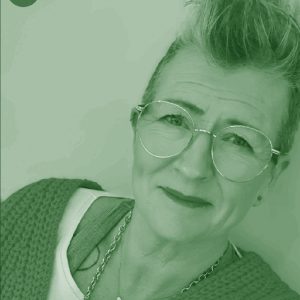
Mia is a lecturer at Uppsala University (Sweden), where she researches leadership issues. After 16 years in the Swedish army and a few more as a consultant, she moved to academia. As a young woman, she already enjoyed representing her classmates, because, she says, “you have to make your voice heard in debates, and know how to disagree if necessary”. She thinks that, because she is not afraid to speak out, she is now a member of various university circles on equality issues where she can give her opinion, even if she is sometimes an “uncomfortable voice”.
.
Silvina Chemen

Silvina is rabbi of the Bet El synagogue in Buenos Aires, the largest Hebrew community in Latin America. The daughter of an emigrant Jewish family who, like many, gave more importance to assimilation than to the transmission of traditions. Her youthful dream was to become an educator. She never sought to lead a community, but rather, having certain talents, she began replacing rabbis and found herself in the role of rabbi “because the community asked me to, and I feel that it was the community that put me there”. An example of bottom-up leadership.
Sobre l´autor

De l’Empordà als Andes: les bones rutes rarament són rectilínies. Pel camí, moltes trobades i ensenyaments – i els que vindran! Tot plegat m’ha portat al turisme, en el qual ensenyo i faig recerca.